
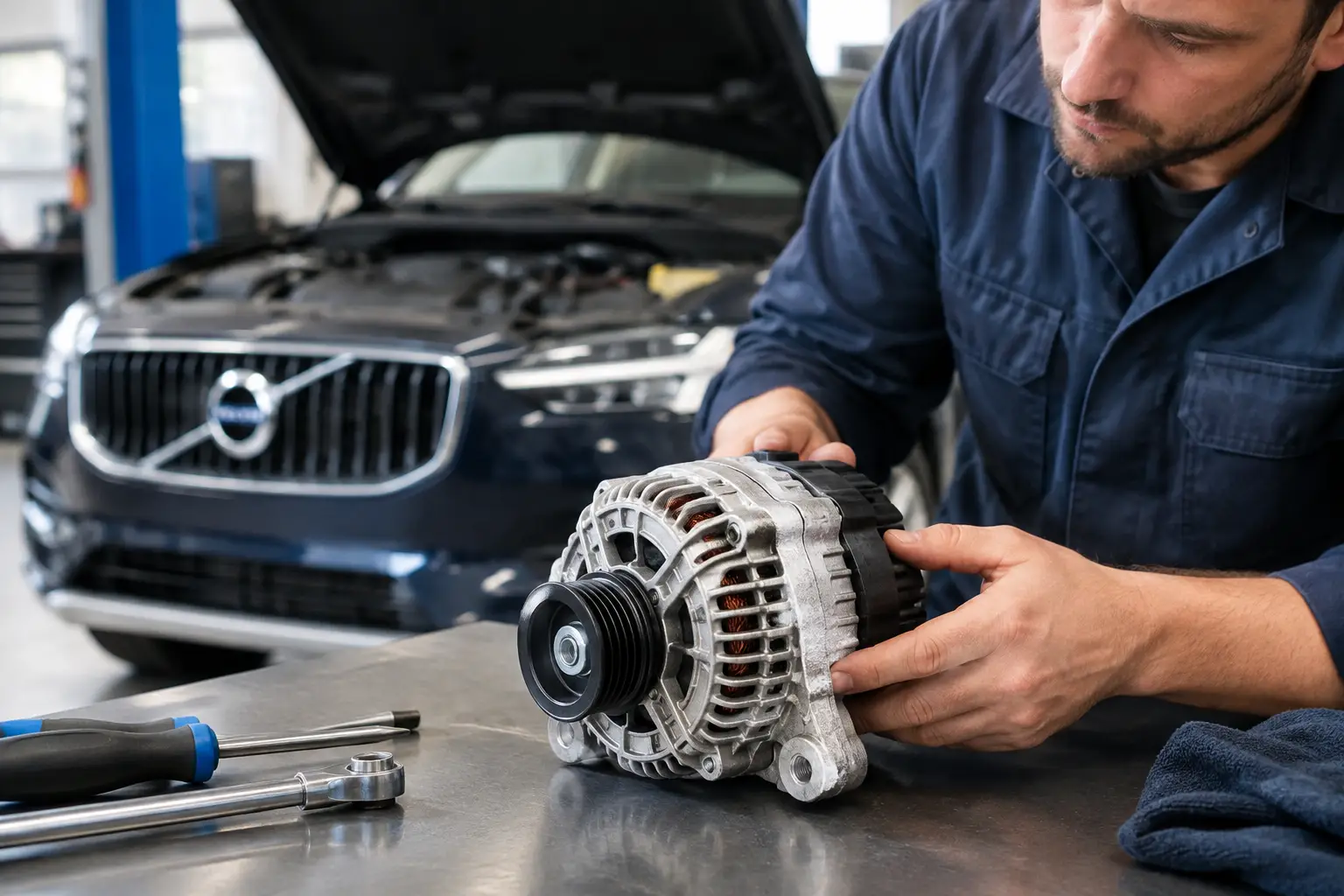
A Volvo that starts normally in the morning but shows a battery warning light on the expressway needs attention quickly. Volvo alternator failure does not always mean the car will stop immediately, but it can leave you with a flat battery, reduced electrical functions and a vehicle that will not restart once switched off.
The alternator keeps the battery charged while the engine is running and supplies power to systems including lighting, climate control, infotainment, engine management and safety electronics. Modern Volvos rely heavily on stable electrical voltage, so a charging fault should be diagnosed properly rather than treated as a simple battery issue.
Volvo alternator failure warning signs
The clearest sign is the red battery or charging-system warning light. Despite its symbol, this light does not automatically mean the battery itself has failed. It often indicates that the battery is not being charged correctly while driving.
You may also notice headlights that appear dimmer than usual, interior lights that flicker, slow electric windows, an erratic infotainment screen or warning messages that seem unrelated. On some Volvo models, low system voltage can trigger multiple alerts at once. This can be alarming, but the root cause may be one charging fault rather than several separate component failures.
A whining, grinding or chirping sound from the auxiliary-belt area also deserves investigation. The alternator contains bearings and is driven by a belt system. A worn bearing, failing pulley, damaged belt or weak tensioner may affect alternator operation before charging stops completely.
If the engine cranks slowly after a drive, or the car needs repeated jump-starts despite having a relatively new battery, do not assume the replacement battery is defective. A weak alternator may be leaving it undercharged. Equally, an alternator can be healthy while an old battery can no longer retain enough charge. Testing both is the sensible approach.
Why alternators fail on Volvo cars
Age, heat and mileage all take their toll. Alternators work in a high-temperature environment and contain electrical components, brushes, bearings and a voltage regulator. Over time, these parts wear or lose their ability to maintain the correct output.
A damaged auxiliary belt or tensioner can also create a charging problem. If the belt slips, the alternator may not spin at the required speed. On certain engines, belt-related faults can have wider consequences, so they should never be ignored simply because the car still runs.
Battery condition matters too. A heavily discharged or failing battery places extra demand on the charging system. Short urban journeys, long periods without use and frequent stop-start operation can all prevent a battery from reaching a full charge. In Singapore’s heat, battery life can be shorter than many owners expect, which makes routine battery and charging checks worthwhile.
Corroded terminals, loose wiring, damaged connectors and poor earth connections may imitate alternator failure. There are also model-specific possibilities, including battery monitoring sensor issues, control-module faults or software-related charging management behaviour. That is why replacing the alternator without diagnosis can become an expensive guess.
The difference between an alternator fault and a battery fault
A battery stores electrical energy. The alternator generates it once the engine is running. If the battery is weak, the engine may struggle to start but the voltage can recover once the alternator begins charging. If the alternator has failed, the car may start with a jump but will gradually run on the battery alone until the available power is exhausted.
Voltage readings help, but they need interpreting correctly. A workshop will check battery health, charging voltage, charging current where appropriate, belt condition and fault codes. A reading that looks acceptable at idle may not tell the full story if the output drops under load or when the engine is hot.
What to do when the battery warning light appears
If the warning light comes on while driving, reduce electrical load where it is safe to do so. Turn off unnecessary accessories such as seat heating, high-demand charging devices and, where conditions allow, non-essential climate settings. Do not switch off headlights if visibility requires them.
Avoid taking a long journey in the hope that the issue will clear itself. If the alternator is no longer charging, every minute of driving uses more of the battery’s remaining reserve. Once voltage falls too low, the engine management system and other electronics may stop operating correctly.
Choose a safe place to stop and arrange an inspection. If the vehicle also shows overheating, a strong burning smell, belt noise, steering changes or several serious warning messages, stop as soon as it is safe. A failed belt drive may affect more than the alternator depending on the engine configuration.
Do not rely on repeated jump-starts. They may get the car moving temporarily, but they do not repair the charging fault and can leave you stranded in a less convenient location.
Proper diagnosis before repair
A professional alternator diagnosis should start with a visual check of the battery terminals, cables, earth points, auxiliary belt, tensioner and alternator connections. The technician can then test the battery’s condition and measure the charging system with the engine running.
Modern Volvo diagnostics add another layer. The vehicle may record fault codes relating to charging control, battery monitoring or communication between modules. These codes do not replace physical tests, but together they help identify whether the problem is the alternator, its regulator, the belt drive, wiring or the battery itself.
This process matters because low voltage can create misleading faults. Replacing a sensor or module because of a warning message, before resolving a charging issue, may not address the actual problem. An experienced Volvo specialist will stabilise the electrical system first and then confirm whether any remaining fault requires further work.
Repair or replacement: what makes sense?
In some cases, alternators can be rebuilt with new internal components. This may appear cheaper initially, but the quality of the rebuild, availability of correct parts and warranty coverage all matter. For a premium vehicle that depends on consistent electrical performance, a poor-quality repair can create repeat faults and additional labour costs.
A new, quality replacement alternator is often the more dependable option when the original unit has failed internally or has high mileage. The right choice depends on the model, engine, condition of the existing unit and parts availability. The alternator should also be matched correctly to the vehicle specification, as output ratings and electrical configurations can differ across Volvo variants.
If the auxiliary belt, tensioner or pulley shows wear, addressing it during the same repair can be sensible. Reusing a damaged belt system with a replacement alternator risks shortening the life of the new part. Likewise, a battery that has been repeatedly drained may need testing again after the charging repair. Deep discharge can reduce battery capacity permanently.
At MTE Garage, Volvo charging-system faults are assessed as a complete system, not just by fitting parts around a warning light. That means checking the source of the issue, using quality new replacement parts where required and explaining the repair before work begins.
Can you prevent alternator problems?
No alternator lasts forever, but regular servicing helps identify related issues early. During routine maintenance, checks of the battery, terminals, belt condition and unusual noises can reveal wear before it becomes a breakdown.
Be alert after a battery replacement as well. If the new battery repeatedly goes flat, needs frequent charging or triggers a warning light, arrange a charging-system test rather than continuing to replace batteries. The same applies if your Volvo has been parked for an extended period. A discharged battery may be the result of inactivity, but it is still worth confirming that the alternator restores the charge properly once the car is back in use.
Electrical faults are rarely convenient, but prompt diagnosis gives you the best chance of avoiding a roadside recovery and protecting the systems your Volvo depends on every day.