
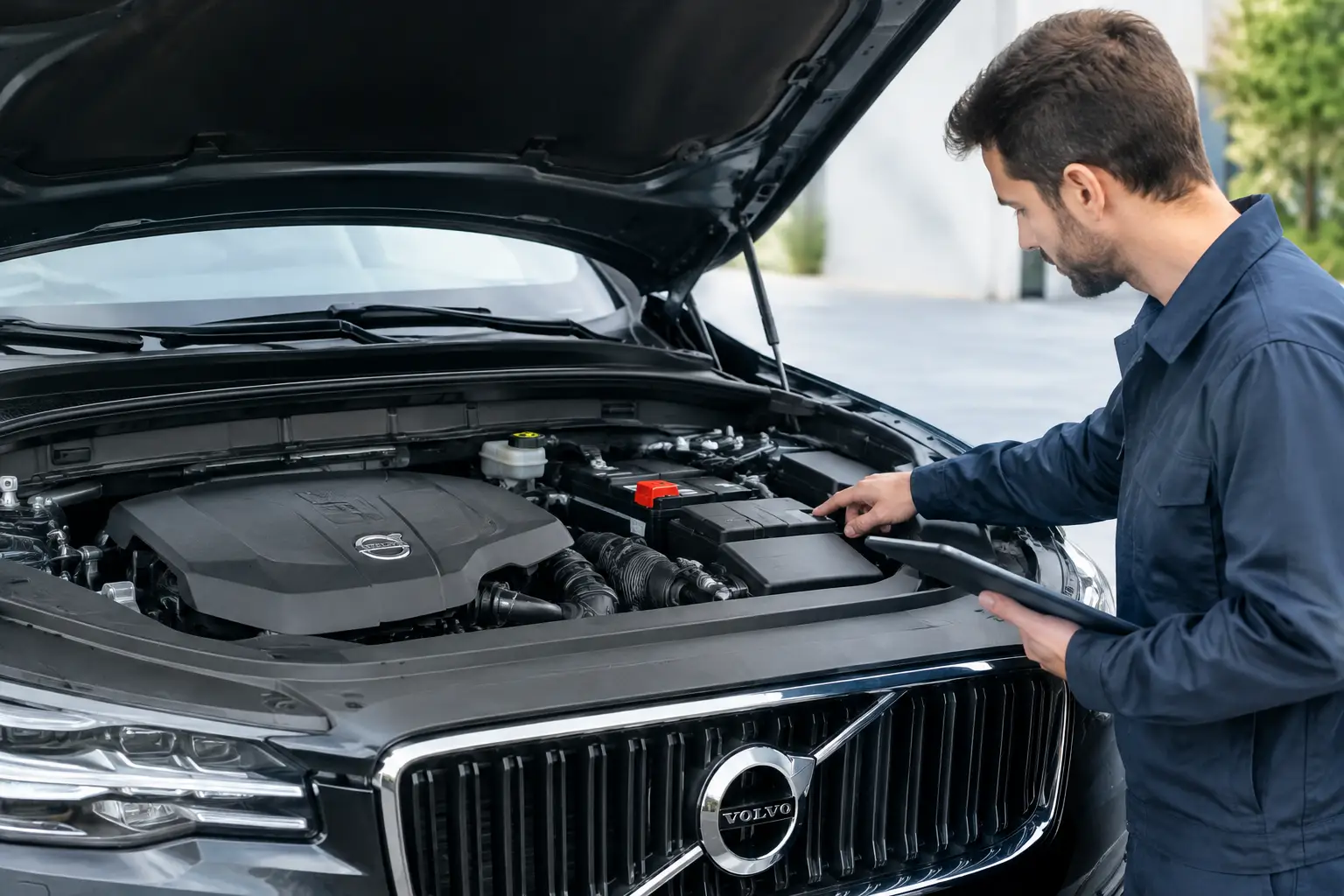
A Volvo that will not start outside the office, at the school run or before an early appointment is more than an inconvenience. Understanding why Volvo batteries fail helps owners act before a weak battery becomes a recovery call, a missed journey and a larger diagnostic bill.
Modern Volvos rely on far more electrical equipment than older cars. Keyless entry, alarm systems, infotainment, parking cameras, driver-assistance functions and multiple control modules all depend on stable voltage. When the battery weakens, the vehicle may still start one day and then produce a string of warning messages the next. The battery is a service item, but the reason it has failed is not always simply its age.
Why Volvo Batteries Fail Earlier Than Expected
The most common cause is normal battery deterioration. A conventional 12-volt battery gradually loses its ability to hold and deliver charge, particularly after three to five years. Singapore’s constant heat can shorten that lifespan. High under-bonnet temperatures accelerate chemical wear inside the battery, while short journeys may not give the alternator enough time to restore the charge used during starting.
Volvos with start-stop systems usually use an AGM or EFB battery rather than a basic lead-acid unit. These batteries are designed to cope with repeated starting and higher electrical demand, but they still wear out. Fitting a cheaper battery with the wrong specification can cause poor start-stop performance, warning lights and a much shorter replacement interval.
A battery can also lose charge because the car is not driven often enough. Leaving a Volvo parked for extended periods does not stop electrical consumption. The alarm, central locking receiver, security systems and control modules continue to draw a small amount of power. A healthy battery can handle this for a time, but an older or partly discharged unit may not recover after a few quiet weeks.
Electrical Demand Can Expose a Weak Battery
A battery may appear fine during a quick check yet struggle under real load. Starting the engine, running the air-conditioning, using lights in heavy rain, charging phones and operating the infotainment system all place demand on the electrical system. This does not mean the accessories caused the failure. More often, they expose a battery that has already lost capacity.
Volvo owners should pay attention to changes that seem minor at first. Slower cranking, dimming interior lights, an intermittent start-stop function or repeated prompts relating to low battery charge are useful warnings. A dashboard message may disappear after a longer drive, but that does not prove the battery is healthy. Voltage can rise temporarily after charging while the battery’s ability to hold that charge remains poor.
Modern vehicles are particularly sensitive to low voltage. A weak battery can trigger messages for systems that are not actually faulty, including parking sensors, steering assistance, transmission functions or driver-support features. Replacing parts based only on those messages is rarely the sensible first step. The battery and charging system should be tested properly before assuming there is a more serious fault.
Heat, Short Trips and Stop-Start Driving
Singapore driving creates a difficult combination for any battery. Heat affects battery chemistry, while congested routes often mean low average speeds and frequent stops. On a short trip, the engine uses a significant burst of energy to start, yet there may be limited time for the alternator to replace it.
This is especially relevant for vehicles used for brief daily journeys. A Volvo driven ten minutes to work, parked all day and then driven home in traffic can gradually operate in a state of partial charge. The issue may not be obvious until a weekend outing, an airport trip or a rainy morning places extra load on the battery.
A longer regular drive can help, but it is not a cure for a worn-out battery. Once capacity has dropped substantially, driving alone will not restore it. A workshop test under load gives a more reliable answer than judging the battery by whether the engine happened to start that morning.
The Alternator May Not Be the Only Issue
When a battery repeatedly goes flat, many drivers immediately suspect the alternator. A charging-system fault is possible, but it is only one cause. The alternator may charge correctly while the battery cannot retain the energy supplied. Equally, a replacement battery can fail prematurely if there is an excessive parasitic draw while the vehicle is parked.
Parasitic drain can result from an accessory, a module that does not enter sleep mode, an aftermarket camera, a tracker or a wiring issue. Finding it requires proper diagnostics rather than replacing batteries one after another. The technician needs to check battery condition, charging voltage and current draw after the vehicle has shut down fully. This is where Volvo-specific knowledge saves time and prevents guesswork.
Signs Your Volvo Battery Needs Attention
Do not wait until there is complete silence when you press the start button. A tired battery often gives notice. The engine may crank more slowly, the car may need a second attempt to start, or the start-stop system may stop operating even after a reasonable drive. You may also notice the clock resetting, infotainment behaving unusually or warning messages appearing briefly at ignition-on.
Corrosion around the terminals, a swollen battery case or a sulphurous smell should be dealt with promptly. These signs can indicate physical battery damage, poor connection or leakage. Do not attempt to force loose terminals into place or continue using a visibly swollen battery. It should be inspected and replaced safely.
If the vehicle starts only with a jump-start, avoid treating that as a permanent solution. A jump-start gets the car moving, but it does not identify whether the problem is battery age, poor charging or an electrical drain. Repeated jump-starting can also create avoidable risk for sensitive electronics if performed incorrectly.
The Right Replacement Battery Matters
Choosing a battery by size alone is a false economy. The correct replacement must match the vehicle’s battery technology, physical fitment, terminal layout and required cold-cranking performance. Start-stop Volvos commonly require AGM batteries, and fitting a standard flooded battery in their place can lead to early failure.
Some newer Volvo models also require battery registration or resetting of the battery monitoring system after replacement. This tells the vehicle that a new battery has been installed, allowing its charging strategy to adapt correctly. Skipping this step may reduce battery life or prevent the system from managing charge as intended.
A quality replacement is worth the difference because it protects the wider electrical system. At MTE Garage, battery concerns can be assessed with a proper condition and charging check, followed by replacement with a suitable new unit where required. That gives owners a clear answer rather than a guess based on a dashboard warning.
What to Do Before the Battery Lets You Down
If your Volvo is approaching four years on the same battery, has been parked for long periods or is showing intermittent electrical warnings, arrange a battery and charging-system inspection. It is a quick preventative check compared with dealing with a no-start at the roadside.
For cars that are used infrequently, a suitable battery maintainer can be helpful, provided it is connected correctly and the vehicle is stored safely. Owners who regularly make short trips should also be realistic about battery wear: the car may need a replacement sooner than its mileage suggests.
A dependable Volvo starts with stable electrical power. Addressing early warning signs with the correct test and the right battery keeps a small maintenance job from becoming the reason your day stops before it begins.