
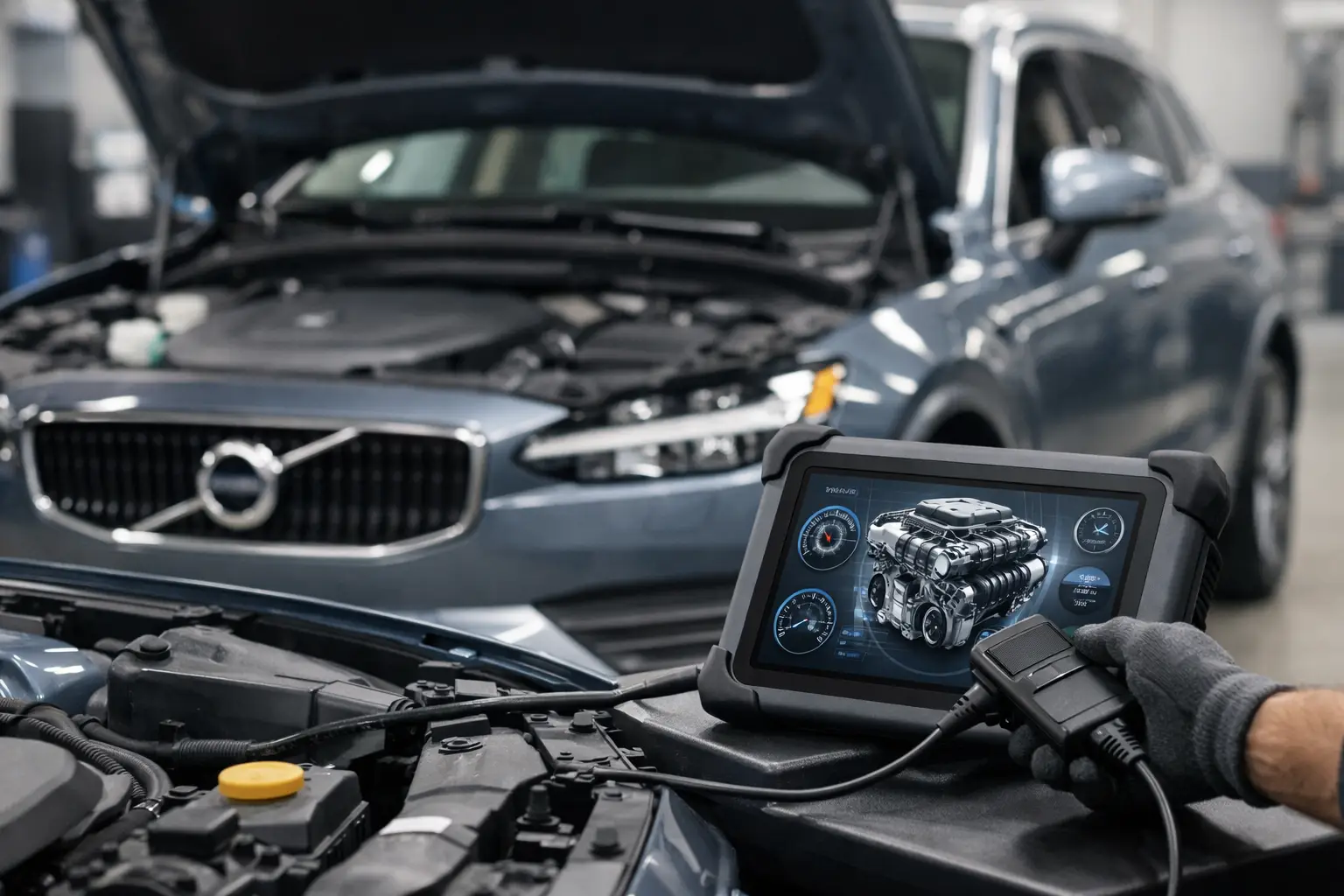
A warning light appearing on the dashboard is rarely the time for guesswork. Your car may still feel normal, but modern Volvo and European engines rely on closely monitored systems for fuel delivery, ignition, emissions, cooling and air intake. This car engine diagnostics guide explains what a proper diagnosis involves, what a fault code can tell you, and when your vehicle should be inspected by a specialist.
For premium cars, a quick code read is not the same as finding the cause. Replacing parts based on a single dashboard warning can be expensive and may leave the original fault unresolved. Professional diagnostics identify the issue before repair work begins, protecting both your vehicle and your budget.
When your car needs engine diagnostics
The engine management light is the most obvious sign, but it is not the only one. A vehicle can store fault information before a warning becomes urgent, and some symptoms deserve attention even when no light is displayed.
Book an engine diagnostic inspection if you notice four or more of the following issues, or if any one symptom is severe:
- The engine management, EPC, emissions or reduced-power warning light is on.
- The car hesitates, misfires, stalls or struggles to accelerate.
- Fuel consumption has increased without a clear change in driving habits.
- The engine idles roughly, vibrates excessively or makes an unfamiliar noise.
- You smell fuel, see unusual exhaust smoke or notice a loss of power.
- The engine runs hotter than normal or the cooling fan operates constantly.
A flashing engine management light requires more caution than a steady one. It can indicate an active misfire that may damage the catalytic converter if the car continues to be driven. Pull over safely where possible and arrange an assessment rather than pressing on to finish a journey.
Car engine diagnostics guide: what happens at the workshop
A reliable diagnosis starts with the driver’s account of the problem. Details matter: whether the fault occurs on a cold start, after rain, under hard acceleration, at motorway speed or only when the air-conditioning is running. These patterns help a technician focus testing on the right systems.
The vehicle is then connected to professional diagnostic equipment. This communicates with the engine control unit and, where relevant, other modules such as the transmission, ABS, battery management and emissions system. The scan can reveal stored and pending fault codes, live sensor readings, freeze-frame data from the moment a fault occurred, and module communication errors.
That information is the starting point, not the final answer. A code may identify a circuit or a system operating outside its expected range, but it does not automatically prove that a particular component has failed. For example, an oxygen sensor code could be caused by the sensor itself, damaged wiring, an air leak, a fuel pressure issue or an exhaust leak affecting its reading.
An experienced technician follows up with physical checks and measured tests. Depending on the symptom, this can include inspecting hoses and wiring, testing battery voltage and charging output, checking ignition components, measuring fuel pressure, assessing compression, looking for intake leaks or examining the condition of the exhaust and catalytic converter. Only then can the repair recommendation be made with confidence.
Why Volvo and continental cars need brand-aware testing
Volvo, BMW, Mercedes-Benz, Volkswagen, Jaguar and other European marques use sophisticated electronic systems that are closely integrated. One weak battery, damaged sensor connection or communication fault can create several warnings at once. Generic scan tools may retrieve basic engine codes, but they do not always provide the complete manufacturer-level information needed for accurate diagnosis.
Volvo models in particular benefit from technicians who understand common platform-specific faults and the way Volvo modules communicate. A warning relating to engine performance may involve the air intake system, turbo control, fuel pressure, emissions equipment or an electrical issue elsewhere on the vehicle. The same dashboard message can have different causes across model years and engine types.
This does not mean every fault is complicated or costly. A loose connector, ageing spark plug or failing battery can be straightforward to correct. The value of specialist diagnostics is knowing the difference before parts are fitted. It avoids the false economy of replacing components that are not responsible for the fault.
Common fault areas and what they may mean
Engine diagnostics often lead to a small group of systems, although the final cause must always be tested. Ignition faults can cause rough running and misfires, particularly under load. Worn spark plugs, faulty ignition coils and moisture in electrical connections are common possibilities.
Air and fuel faults can bring on the engine management light, increase fuel use and reduce performance. A contaminated airflow sensor, intake leak, weak fuel supply or turbo-related issue may all affect the air-fuel balance. On turbocharged engines, split hoses and control faults should not be overlooked.
Emissions-related faults are also common in city-driven cars. The oxygen sensors, catalytic converter, exhaust gas recirculation system and particulate filter all need correct operating conditions to function properly. Short journeys can contribute to certain emissions problems because the engine and exhaust may not reach temperature for long enough. However, a warning light should never be dismissed as simply the result of urban driving without proper testing.
Cooling faults require prompt attention. A thermostat issue, coolant leak, failing water pump, temperature sensor fault or cooling fan problem can cause overheating. Continuing to drive an overheating engine can turn a manageable repair into major engine damage.
What not to do when the warning light appears
Clearing a warning light without investigating the cause is not a repair. The light may remain off temporarily, but the fault can return when the same driving conditions occur. Clearing codes also removes useful freeze-frame information that can help pinpoint the problem.
It is also wise to avoid buying a part simply because an online search connects it to the code shown by a basic scanner. Fault codes are useful, but they need interpretation alongside live data and vehicle testing. This is especially true for expensive items such as injectors, turbochargers, catalytic converters and control modules.
Do not ignore changes in drivability just because the car has passed a recent service. Routine servicing and diagnostics work together, but they are not identical. An oil and filter change will not necessarily identify an intermittent sensor signal, boost leak or electrical communication fault.
Preparing for a diagnostic appointment
Before bringing your car in, make a note of when the issue started and how often it occurs. Mention any recent repairs, battery replacement, accident damage, water exposure or modifications. If the warning appeared after refuelling, record that too. Small details can shorten the diagnostic process.
Try not to disconnect the battery or clear the codes before the inspection unless there is a safety reason to do so. Preserving the fault history gives the technician more evidence to work with. If the car is in reduced-power mode, misfiring heavily, overheating or displaying a red warning, tell the workshop before travelling so the safest next step can be advised.
A diagnosis should lead to a clear repair plan
After testing, you should receive a straightforward explanation of the fault, the recommended repair and any work that may be sensible to address at the same time. A good workshop will distinguish between an urgent safety or reliability issue and maintenance that can be planned for later.
At MTE Garage, diagnostic work is approached with the same practical standard as servicing and repairs: identify the actual cause, use quality new parts where replacement is required, and keep the recommendation clear. For Volvo and continental car owners, this is the sensible way to protect performance without paying for unnecessary parts.
If your engine warning light is on or your car is not driving as it should, arrange an inspection early. A proper diagnosis can turn an uncertain dashboard warning into a defined repair before a small fault becomes an inconvenient breakdown.