
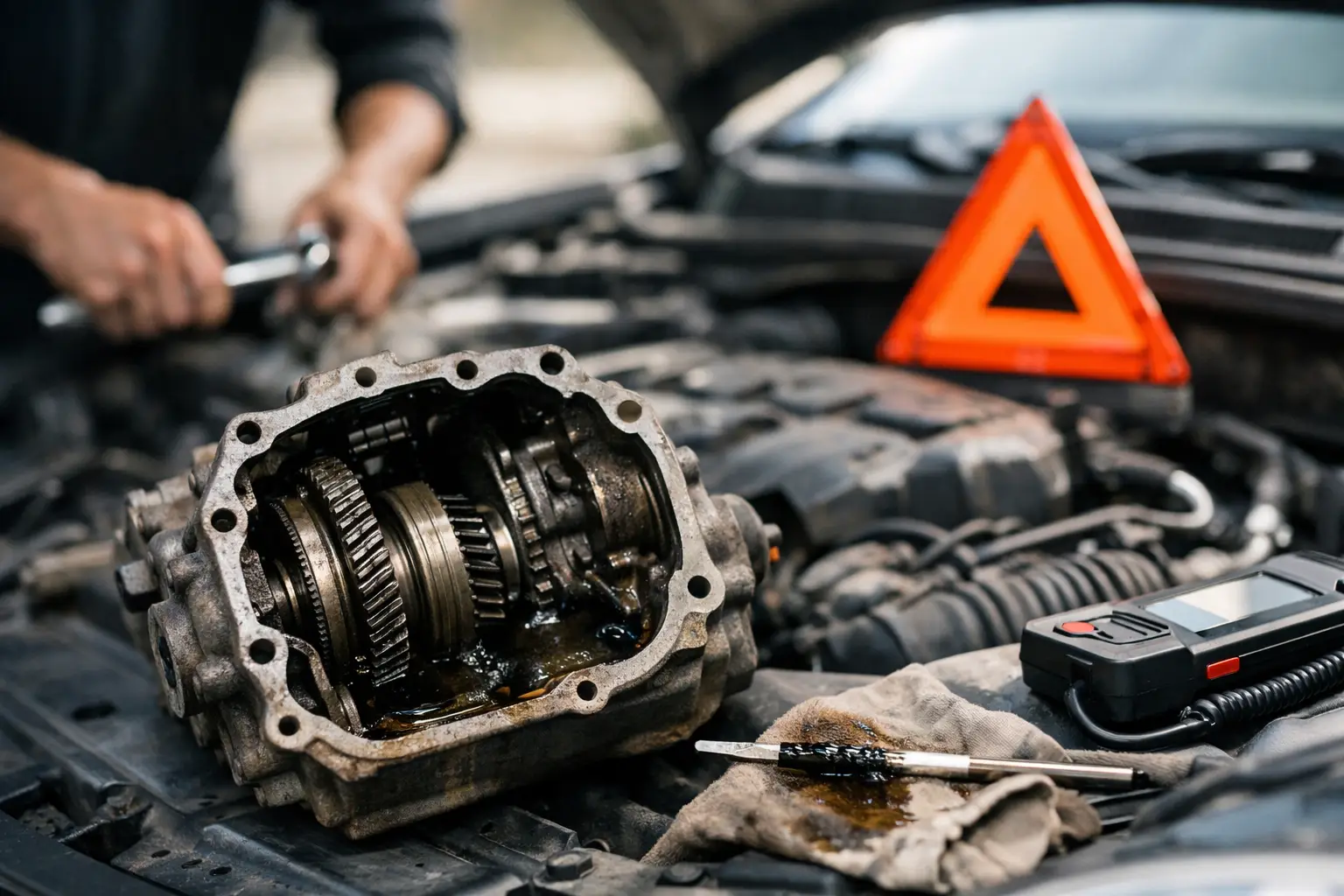
A gearbox fault rarely starts with a complete breakdown. More often, it begins with a change you notice on the morning drive: a hesitation at a junction, a thump during an upshift, or an unfamiliar whine at speed. Knowing the top signs of gearbox trouble gives you the chance to act before a manageable repair becomes a costly rebuild.
For Volvo and other premium European car owners, this matters particularly. Modern automatic and dual-clutch transmissions are sophisticated units, and they rely on the correct fluid, accurate diagnostics and proper repair procedures. Ignoring a small change in how the car drives is not a saving – it can allow heat, wear or low fluid pressure to cause further damage.
Delayed engagement when selecting Drive or Reverse
A healthy gearbox should engage Drive or Reverse promptly when the vehicle is stationary and your foot is on the brake. If there is a noticeable pause before the car begins to move, or the gear engages with a hard bump, the transmission needs attention.
This can be caused by low or degraded transmission fluid, a valve body issue, worn internal components or an electronic control fault. It is especially worth checking if the delay is becoming more frequent, happens after the car has warmed up, or is accompanied by a warning message on the dashboard.
Do not compensate by pressing the accelerator harder. That can make the engagement harsher and place more load on already stressed parts.
Rough, jerky or unusually hard gear changes
Automatic gear changes should feel controlled and predictable. You may notice a gear change occasionally under hard acceleration or on a steep incline, but repeated jolts, bangs or sharp surges are not normal.
Some drivers first notice this in slow traffic, where the gearbox moves between lower gears more often. Others feel it when accelerating onto an expressway, particularly if the car hesitates before changing up. In a dual-clutch transmission, a judder when pulling away can also point to clutch wear, adaptation issues or contamination.
A gearbox service may help when fluid condition is the underlying issue, but it is not a universal cure. The right repair depends on the fault codes, fluid inspection, road test results and the transmission fitted to your vehicle. A specialist workshop should diagnose the cause before recommending work.
When a hard shift needs urgent attention
Book an inspection promptly if a hard shift comes with a loss of power, a flashing warning light, a burning smell or a sudden refusal to change gear. Continuing to drive in these conditions can damage the gearbox further and may leave you stranded.
Slipping gears or rising revs without acceleration
Gearbox slipping is one of the clearest warning signs. The engine revs climb, but the car does not accelerate as it should. It can feel as though the transmission has briefly selected neutral before finding the next gear.
This may happen when overtaking, climbing a hill or accelerating from a standstill. In manual vehicles, a slipping clutch can create similar symptoms. In automatics, the problem may involve internal clutch packs, fluid pressure, torque converter operation or electronic controls.
Do not assume the issue will settle after a few drives. Slipping creates heat, and excess heat is one of the quickest ways to shorten the life of a transmission. Reduce heavy acceleration and arrange a diagnostic check as soon as possible.
Unusual noises from the transmission area
A gearbox does not need to be silent, but new noises deserve investigation. A whining sound that rises with road speed, a humming noise in a particular gear, grinding during a change, or a clunk when engaging Drive can all indicate a developing fault.
The source is not always the gearbox itself. Driveshafts, wheel bearings, engine mounts and differential components can produce similar sounds. That is why accurate diagnosis matters. Replacing parts based on guesswork is expensive, particularly on premium European vehicles where components and labour are not cheap.
Make a note of when the noise appears: cold or warm, under acceleration or on the overrun, in one gear or every gear. These details help technicians narrow down the cause quickly.
Transmission warning lights and dashboard messages
A gearbox warning light, engine management light or message such as “transmission service required” should never be ignored. The car may still drive normally at first, but the control module may have detected a pressure, temperature, speed sensor or communication problem before it becomes obvious to the driver.
Some vehicles enter a reduced-power or limp-home mode to protect the transmission. You may be limited to one gear, experience very slow changes or find that the car will not select certain gears. This is a protective response, not a problem to reset and forget.
A diagnostic scan can identify stored fault codes, but codes are the starting point rather than the final answer. Experienced technicians will assess live data, wiring, fluid condition and mechanical operation before deciding whether the issue is electrical, hydraulic or internal.
Fluid leaks, overheating and burning smells
Transmission fluid is essential for lubrication, cooling and hydraulic control. If you see red, brown or dark fluid beneath the car, have it checked. Not every gearbox fluid is red, and some leaks may be engine oil or coolant, but any unexplained fluid loss warrants professional inspection.
A burning smell after driving in traffic, towing, climbing or carrying a full load can indicate overheated transmission fluid. In Singapore’s heat and stop-start conditions, a neglected gearbox can work harder than many owners realise. Old fluid loses its ability to protect moving parts and manage heat effectively.
It is equally unwise to top up with a generic fluid. European gearboxes often require a specific manufacturer-approved specification. Using the wrong product can affect shift quality, seals and long-term reliability.
Poor response in manual mode or when changing down
If your car has manual or sport mode, use it only as a reference point, not as a way to mask a fault. A slow response to paddle inputs, refusal to downshift when appropriate, or a harsh change when selecting manual mode can point to transmission control issues.
You may also feel a jolt when slowing down as the gearbox changes to lower gears. A mild change can be characteristic of some models, especially when cold. However, a new or worsening thump should be assessed, particularly if it occurs alongside delayed engagement or warning lights.
Top signs of gearbox trouble are not always gearbox failure
There is a practical distinction between a gearbox symptom and a failed gearbox. A flat battery, charging fault, damaged wiring, weak engine mount, software issue or sensor failure can affect the way a transmission behaves. This is good news when caught early, but only if the vehicle is assessed properly rather than treated with a one-size-fits-all repair.
For that reason, avoid agreeing to a gearbox replacement based solely on a dashboard light or a brief test drive. Ask for a clear explanation of the findings, the parts required and whether there are repair options before a replacement unit is considered.
What to do when you notice a problem
If the car still drives safely, avoid aggressive acceleration, heavy loads and unnecessary long journeys until it has been inspected. Take note of the symptoms and whether they occur when cold, after warming up, at a certain speed or in a specific gear. If a warning light is flashing, the car is stuck in one gear, there is a strong burning smell or fluid is leaking heavily, stop driving and arrange assistance.
Regular servicing remains the best defence. Service intervals vary by model and gearbox type, so do not rely on broad claims that transmission fluid lasts forever. A proper maintenance plan considers your vehicle’s age, mileage, driving conditions and manufacturer requirements.
At MTE Garage, our technicians diagnose gearbox concerns with the care premium European vehicles require, using quality parts and practical workshop experience to recommend the right work – not unnecessary work. A prompt inspection can protect the smooth, dependable drive you bought the car for.