
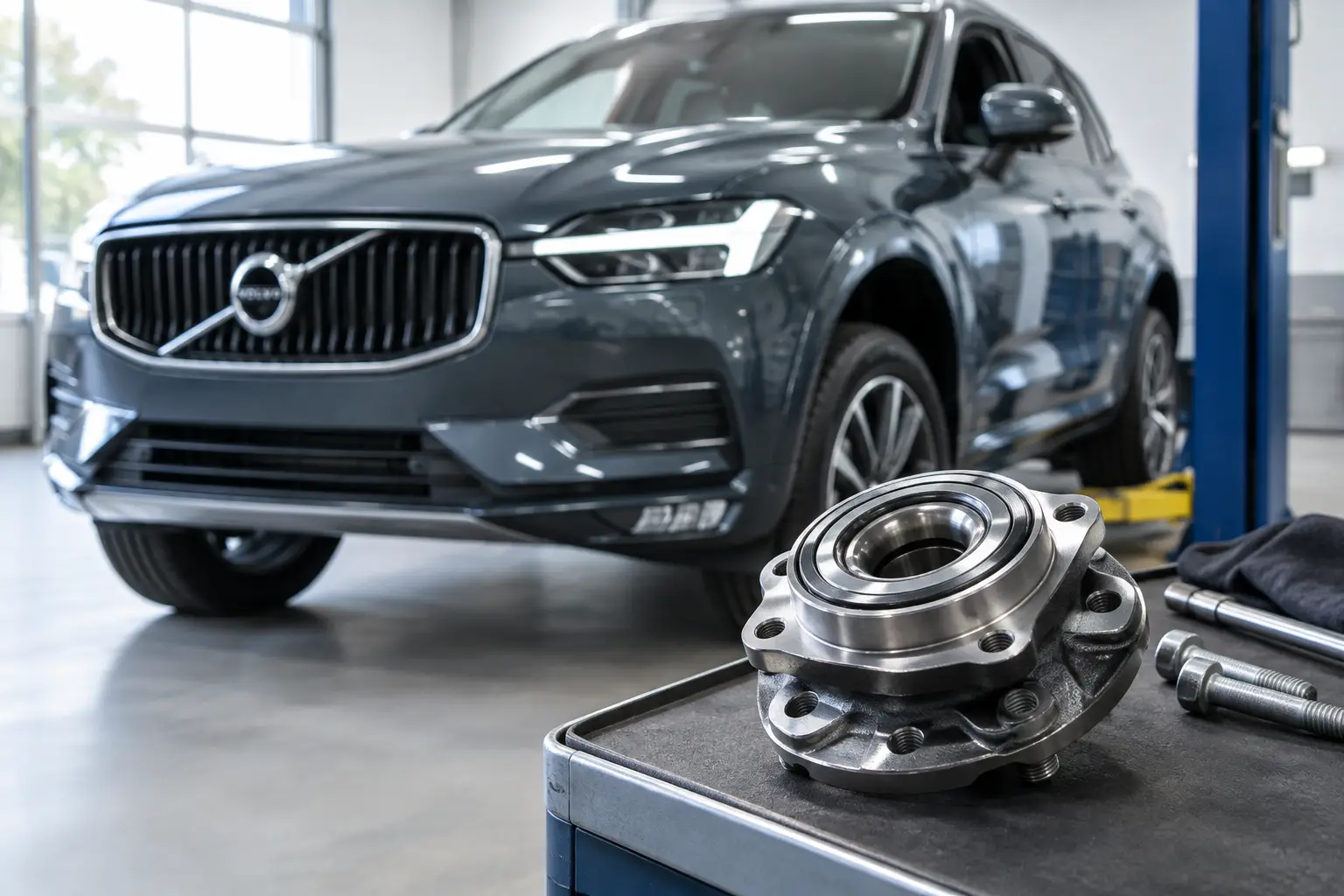
A low droning sound that gets louder as your Volvo picks up speed is easy to dismiss at first. Many drivers assume it is tyre noise, rough road surface or simply the character of an older car. But a failing Volvo wheel bearing can produce exactly this sound – and leaving it unchecked can turn a straightforward repair into a safety concern and a more expensive workshop visit.
Wheel bearings carry a significant load every time you drive. They allow each wheel to rotate smoothly while supporting the vehicle’s weight through corners, over bumps and during braking. On a Volvo, where ride quality, stability and long-distance comfort matter, a worn bearing can quickly affect how assured the car feels on the road.
What a wheel bearing does on your Volvo
The wheel bearing sits within the wheel hub assembly and supports the rotating wheel. Modern Volvo models commonly use sealed hub-bearing units. These are designed to last well, but they are not lifetime components. Once wear develops inside the sealed unit, it is normally replaced rather than repaired.
A healthy bearing keeps the wheel turning freely and precisely. A worn one can create friction, noise and movement at the wheel. Depending on the model and fault, it may also affect sensor signals used by the ABS, traction control and stability systems.
This is why the job should not be approached as a generic parts swap. Correct diagnosis matters. A similar noise may come from tyres, brake components, a driveshaft, differential or drivetrain, particularly on all-wheel-drive Volvo models. Replacing a wheel bearing without confirming the source wastes time and money.
Common Volvo wheel bearing warning signs
The most familiar sign is a humming, growling or rumbling noise that rises with road speed. It is usually more noticeable from around urban driving speeds onwards and may become louder on faster roads. Unlike engine noise, it does not disappear when you lift off the accelerator.
The sound may also change as the car turns. During a left-hand bend, extra load is placed on the right-hand wheels, and vice versa. If the noise becomes more pronounced under one direction of cornering, it can help a technician narrow down the affected side. It is a useful clue, but not a final diagnosis on its own.
Other symptoms can include:
- vibration through the steering wheel, floor or seat at speed;
- a steering feel that is less settled than usual;
- uneven tyre wear caused by excessive wheel movement;
- an ABS, traction control or stability-control warning light on certain models;
- noticeable play, clunking or a rough feel when the wheel is inspected off the ground.
A warning light is not guaranteed. Some bearings fail mechanically without affecting the wheel-speed sensor, while others can cause an intermittent sensor-related fault before the bearing noise becomes obvious.
Why wheel bearings fail
Age and mileage are part of the picture, but mileage alone does not predict when a bearing will need attention. A Volvo used mostly on smooth roads may retain its original bearings for a long time. One that regularly encounters potholes, kerbs, flooded roads or heavy loads may need work earlier.
Hard impacts are a common cause. Striking a deep pothole or kerb can damage the bearing races or hub, even if there is no immediate visible damage to the wheel. Repeated impacts gradually add up as well. This is especially relevant where road conditions, car park ramps and speed humps place regular stress on suspension and wheel components.
Water ingress can also shorten bearing life. Although modern units are sealed, damaged seals, corrosion or contamination can allow moisture to affect the bearing internally. Incorrect installation is another avoidable cause. A bearing must be fitted with the right equipment and procedures, as force applied through the wrong part of the assembly can damage a new unit before the car has even left the workshop.
Do not confuse tyre noise with bearing noise
Tyres often create noise that sounds remarkably similar to a worn bearing. Cupped or scalloped tyre wear, uneven tread blocks and certain tyre patterns can produce a constant drone that changes with road surface. This is why a quick listen from the driver’s seat is not enough.
A proper inspection includes checking tyre condition and pressures, rotating each wheel, testing for free play and listening carefully at the hub. Where needed, road testing and diagnostic equipment help identify whether the noise is mechanical or sensor-related. On a Volvo with multiple possible driveline noise sources, this disciplined process avoids replacing parts by guesswork.
There is also a practical trade-off. If the tyres are badly worn and are clearly causing the noise, fitting a wheel bearing will not solve it. Conversely, assuming every hum is tyre noise may allow a worn bearing to deteriorate further. The right answer comes from inspection, not assumption.
Is it safe to keep driving?
A mild bearing noise does not always mean the wheel is about to fail that day, but it should be booked in promptly. Bearing wear normally gets worse, not better. As internal damage develops, the noise can increase and heat can build up around the hub.
If there is wheel play, a grinding sound, a strong vibration, a burning smell near a wheel, or warning lights alongside a change in handling, the car should be inspected urgently. Avoid high speeds, long journeys and heavy loading until the fault has been assessed.
In severe cases, excessive movement can affect braking performance, tyre wear and wheel alignment. A badly worn hub assembly can also place additional stress on surrounding components. The cost of early replacement is generally far preferable to dealing with consequential damage later.
Choosing the right replacement parts
For a Volvo wheel bearing replacement, part quality matters. The bearing carries vehicle load, transfers forces from the road and operates in a high-temperature environment close to the brakes. A poor-quality unit may be cheaper at the counter but can introduce noise, premature wear or sensor faults.
A specialist workshop should select a correct-fit, high-quality replacement suitable for the exact Volvo model, year and drivetrain. This is particularly important because hub designs, sensor arrangements and fastener specifications vary between vehicles. An XC60, V40, S90 and XC90 may all require different parts and procedures.
It is also sensible to inspect the surrounding area while the vehicle is on the ramp. Brake discs and pads, tyres, suspension joints and driveshafts can all contribute to noise or show signs of the same impact that damaged the bearing. That does not mean replacing parts unnecessarily. It means giving clear advice on what needs attention now, what can be monitored and what is in good order.
Should both wheel bearings be replaced together?
Not necessarily. Unlike brake pads or tyres, wheel bearings do not automatically need replacing in pairs. If testing confirms one bearing is worn and the bearing on the opposite side is quiet, smooth and free from play, replacing only the faulty unit is usually the sensible option.
However, if both sides have covered similar mileage in demanding conditions, or both are showing early signs of wear, it may be worth discussing the value of doing both. The decision should be based on inspection findings, vehicle condition and your plans for the car – not a blanket rule.
What to expect from a professional repair
A proper wheel bearing repair begins with diagnosis. The technician should confirm the fault, identify the correct side and check for related issues before work begins. Once the replacement is approved, the old hub or bearing assembly is removed using suitable tools, the mounting surfaces are cleaned, and the new component is fitted to the manufacturer’s torque requirements.
After installation, the wheel is refitted correctly and the vehicle is checked for smooth operation. If a warning light or wheel-speed sensor issue was involved, diagnostic checks may be required after the repair. The aim is not merely to make the noise disappear. It is to restore the stability, comfort and confidence expected from your Volvo.
At MTE Garage, Volvo-focused experience helps us diagnose wheel and driveline noises accurately, fit quality new parts and explain the work in plain terms before proceeding. You get practical advice without dealership-level guesswork or unnecessary replacement recommendations.
If your Volvo has started to hum, rumble or feel unsettled at speed, arrange an inspection before a small warning becomes a bigger repair. A clear diagnosis now protects your tyres, braking confidence and the calm, controlled drive your Volvo was built to deliver.