
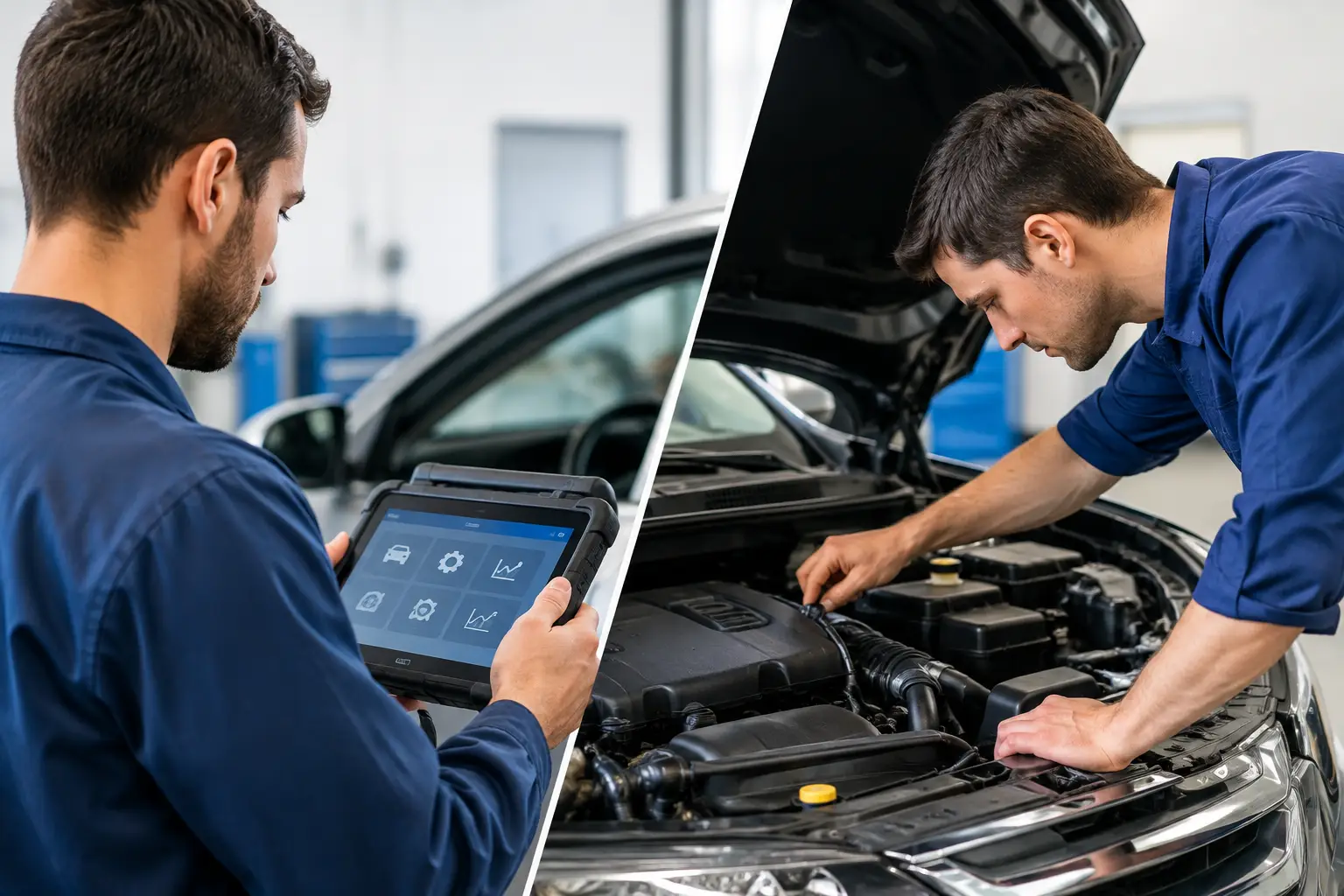
A warning light on a Volvo dashboard can point to a genuine fault, but it rarely tells the whole story. The question is not diagnostic scan versus manual inspection as though one method must replace the other. Accurate repair depends on using the scan tool to identify where to investigate, then using trained eyes, hands and workshop testing to establish what has actually failed.
For premium European cars, this distinction can save considerable time and money. Replacing a part simply because a fault code mentions it is not professional diagnosis. A code is evidence. The technician’s job is to interpret that evidence, inspect the vehicle and confirm the root cause before recommending work.
What a diagnostic scan can tell us
A modern Volvo, BMW, Mercedes or Volkswagen contains multiple electronic control units. These systems monitor engine operation, gearbox performance, braking, emissions equipment, air-conditioning, safety features and more. When a reading falls outside its expected range, the relevant module can store a diagnostic trouble code.
A diagnostic scan gives a technician a fast, structured starting point. It can reveal stored and pending codes, freeze-frame data captured when the fault occurred, live sensor readings and communication issues between vehicle modules. On many continental vehicles, manufacturer-level diagnostic equipment also allows technicians to carry out component tests, calibrations, service resets and software-related checks.
This is particularly valuable when the symptom is intermittent. If an engine management light appeared briefly on the way to work, or a gearbox warning only occurs after the car is fully warm, the stored data may provide the first useful clue even when the vehicle feels normal in the workshop.
A scan is also essential after certain repairs. Electronic parking brakes, battery monitoring systems, adaptive lighting, driver-assistance equipment and transmission control units may need correct procedures after parts are fitted. Skipping these steps can leave a car with warning messages, reduced functionality or an incomplete repair.
A fault code is not a parts list
The limitation is simple: diagnostic equipment reports what the car’s control unit has detected, not necessarily the component that needs replacing. A code for low turbocharger pressure, for example, may relate to a split hose, a sticking actuator, a vacuum leak, a sensor reading, carbon build-up or an issue with the turbocharger itself.
Likewise, a misfire code does not automatically mean an ignition coil is defective. It could be caused by a spark plug, injector, wiring issue, air leak, low compression or fuel supply problem. Replacing the first part named by a generic scanner may clear the light temporarily, but it does not prove the fault has been solved.
This is where experience matters. A specialist technician recognises common model-specific patterns, but still tests rather than guesses. That protects the car and prevents customers from paying for unnecessary parts.
Why manual inspection still matters
Manual inspection is the physical assessment that no scan tool can perform. It includes checking for leaks, damaged wiring, worn components, loose connections, corrosion, fluid condition, unusual noises and evidence of previous repair work. It may also involve a road test, pressure test, battery test, smoke test or measurement of mechanical wear.
Many faults begin as physical problems long before a dashboard warning appears. A small oil leak, cracking auxiliary belt, worn suspension bush, tyre damage or brake disc corrosion may not create a diagnostic code at all. Yet each can affect reliability, safety and future repair costs.
For a Volvo owner, this is especially relevant during routine servicing. The car may show no warnings and drive well, but a close inspection can identify ageing engine mounts, a coolant seep, uneven tyre wear or brake pad movement before the issue becomes urgent. A scan alone cannot assess the thickness of brake pads or whether a rubber hose is beginning to perish.
Manual inspection also gives context to electronic readings. Suppose the scan data shows an implausible intake-air temperature. Before condemning the sensor, a technician should inspect its connector, wiring route and surrounding pipework. Heat damage, oil contamination or a poor terminal connection can create exactly the same electronic symptom as a failed sensor.
The road test is part of the diagnosis
Some faults only become clear when the vehicle is driven. A gearbox may hesitate only under load, a wheel bearing may hum at a particular speed, or a steering vibration may appear only during braking. These symptoms require careful observation and, where appropriate, a controlled road test.
A good technician listens to how the owner describes the problem as well. Details such as when the warning appears, whether it happens in wet weather, whether it follows a battery replacement or whether it occurs only on short journeys can narrow down the investigation quickly. The driver lives with the car. That information is valuable diagnostic data.
Diagnostic scan versus manual inspection: the right workshop process
The most reliable approach combines both methods in a sensible order. The exact process depends on the symptom, but it usually starts with discussing the issue, checking the vehicle’s service history and carrying out an initial visual assessment. The technician then scans all relevant systems, not just the module linked to the dashboard warning.
The stored codes and live data guide further tests. If the scan points towards a charging-system concern, the battery condition, terminals, alternator output and belt drive should be checked. If it identifies a brake-system fault, the technician needs to examine the wiring, sensor position, wheel bearing condition and brake components rather than relying on the code alone.
Once the root cause is confirmed, the workshop can provide a clear recommendation. That should explain what has failed, why it has failed where this is known, what work is required and whether there are any related items worth addressing. This is more useful than a vague instruction to replace a component because a scanner displayed a number.
After repair, a final scan and functional check are often needed to confirm that the system is operating correctly and that no relevant codes return. Where the work affects safety or drivability, the vehicle should also be assessed in real conditions before handover.
When a scan may be enough, and when it is not
There are situations where a diagnostic scan is the main task. Service-light resets, electronic maintenance checks, software configuration procedures and confirming a known historical code may require little more than the correct equipment and process. Even then, a reputable workshop will flag anything visibly concerning.
However, a warning light, rough running engine, weak air-conditioning system, gearbox concern, battery drain, brake warning or recurring fault nearly always needs more than a quick code read. These issues can have several causes, and the cheapest-looking answer is not always the right repair.
Be cautious of workshops that promise a diagnosis within minutes without examining the vehicle. Reading codes is quick. Establishing why the code appeared can take time, specialist equipment and practical judgement. That investigative work is what separates accurate repair from repeated visits for the same problem.
Better diagnosis protects long-term value
Continental cars are engineered with tightly integrated mechanical and electronic systems. A shortcut in one area can cause a problem somewhere else, particularly if poor-quality parts, incorrect fluids or incomplete repair procedures are used. Proper diagnosis helps avoid that cycle.
It also supports sensible maintenance planning. If an inspection identifies early wear but the car remains safe and serviceable, the owner can decide whether to act now or schedule the work around an upcoming service. If a fault risks breakdown, engine damage or compromised braking, the priority is clear. Straightforward advice allows owners to make informed decisions without pressure.
At MTE Garage, the aim is not simply to erase warning lights. It is to find the reason behind them, use quality replacement parts where required and return the vehicle with the work explained clearly. For Volvo and other European vehicle owners, that is the standard worth expecting.
If your car has developed a warning light, unfamiliar noise, change in performance or repeated message on the dashboard, arrange an assessment before it becomes a larger repair. The right answer may begin with a scan, but it should finish with a confirmed diagnosis and confidence in the work carried out.